

Quick Summary
- SEO for accountants is about attracting the right clients, not just traffic. A well-targeted firm can win high-value advisory, SMSF-administration and specialist clients — not just one-off tax returns.
- Structure is the foundation: a dedicated page for each service (tax, BAS/bookkeeping, SMSF administration, advisory) and each location or niche you serve.
- Niche beats generalist. Ranking for “accountant for [industry]” — tradies, medical professionals, ecommerce, property investors — is lower-competition and attracts better-fit clients.
- The financial-year cycle is your content engine. Mapping content to EOFY, BAS quarters, tax time and FBT gives you a year-round calendar competitors don’t think to build.
- Mind the advice-licensing line. Since the accountants’ exemption was repealed in 2016, content that recommends setting up an SMSF or acquiring a financial product is licensed advice. Keep unlicensed content factual and educational.
- Trust signals matter more here. Financial topics are “your money or your life” to Google, so credentials, memberships, reviews and genuine expertise carry weight.
Table of Contents
- What is SEO for accountants?
- Why SEO works differently for accounting firms
- How Google ranks accounting firms
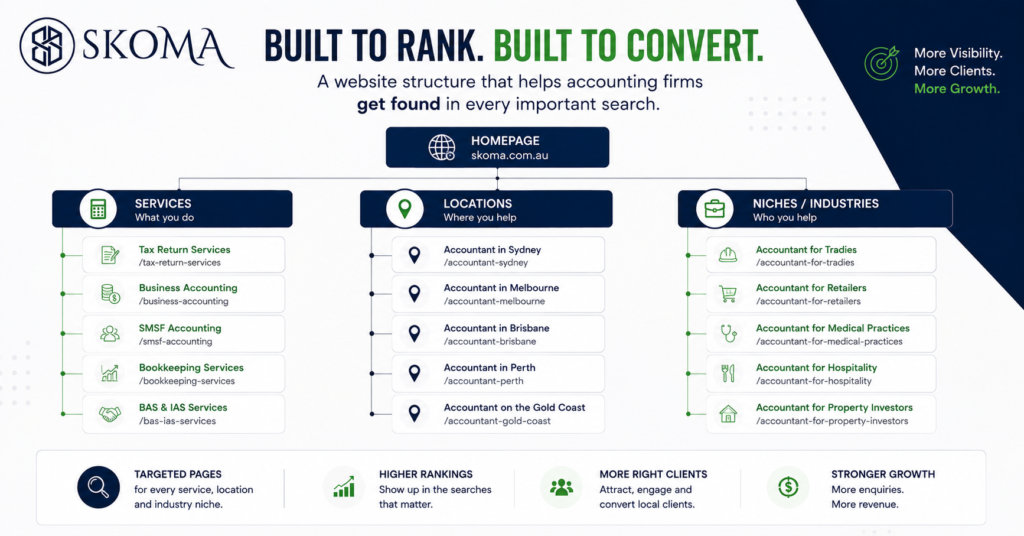
- Your website architecture: services × locations × niches
- The niche advantage: “accountant for [industry]”
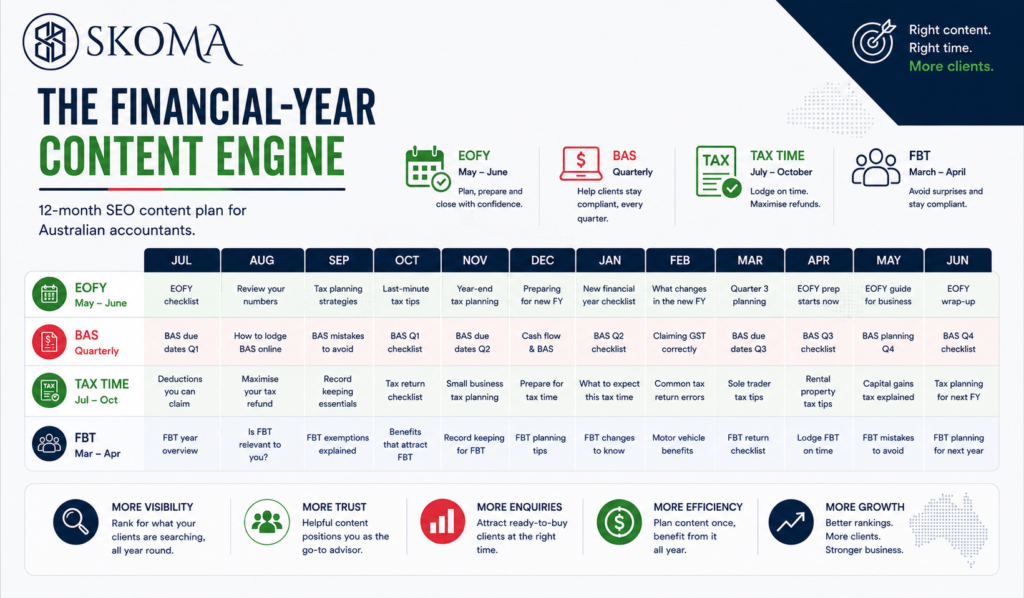
- The financial-year content engine
- The compliance line your content must respect
- Trust, reviews and E-E-A-T for accountants
- Measuring what matters
- Common mistakes
- Frequently asked questions
What Is SEO for Accountants?
SEO for accountants is the work that helps an accounting or bookkeeping firm appear in Google when prospective clients search for the services it offers — whether that’s accountant [suburb], SMSF accountant, bookkeeper for small business or tax agent near me. In practice it means optimising the firm’s website, Google Business Profile and reputation so it ranks for commercially valuable searches and turns those visitors into enquiries.
For accountants, the prize isn’t raw traffic — it’s client quality. A tax-return searcher and an SMSF-administration searcher are worth very different amounts to your firm. Good SEO lets you target the searches that attract the clients you actually want, and to do so within a market where trust and expertise are decisive.
Why SEO Works Differently for Accounting Firms
Three features set accounting SEO apart from a generic local business.
- Client lifetime value is high. Accounting relationships often run for years, so a single new client can be worth many thousands of dollars. That changes the maths — a modest SEO investment pays back on a handful of the right enquiries.
- It’s a “your money or your life” (YMYL) topic. Google applies higher scrutiny to financial content, expecting clear signals of expertise, accuracy and trustworthiness. Thin, generic content underperforms; genuinely expert content is rewarded.
- There’s a compliance layer. Accountants operate under professional and licensing rules that shape what your content can say — particularly around SMSFs and financial products. Most “SEO for accountants” advice ignores this entirely, which is exactly where a firm can get itself into trouble. We cover it properly below.
How Google Ranks Accounting Firms
Google states that local results rest primarily on three factors: relevance, distance and prominence.
| Factor | What it means for an accounting firm | What you control |
| Relevance | How well your profile and site match the search (e.g. “SMSF accountant”) | Categories, listed services, service and niche pages, content depth |
| Distance | How close you are to the searcher or the suburb in the query | Accurate address; and, since many firms now serve clients remotely, clear service-area and national targeting where relevant |
| Prominence | How well-known and trusted your firm appears | Reviews, citations, links, professional memberships, an active, complete profile |
Unlike a mobile tradie, most accounting firms have an office clients can visit, so you’ll usually run a standard storefront Google Business Profile (address shown) rather than a hidden-address service-area listing. That said, remote and cloud-based firms increasingly serve clients Australia-wide — in which case your website’s content and authority do more of the ranking work than proximity does.
Your Website Architecture: Services × Locations × Niches
The firms that rank treat their website like a well-structured set of answers, not a single “about us” brochure.
| Page type | Purpose | Example URL |
| Service page (one per service) | Rank for service intent | /services/smsf-administration |
| Location page (per office/area) | Rank for “accountant [suburb]” | /locations/[suburb] |
| Niche page (per industry served) | Rank for “accountant for [industry]” | /industries/accountant-for-tradies |
| Educational article | Answer client questions; build authority | /blog/eofy-tax-planning-checklist |
| Contact / booking | Convert enquiries | /contact |
Principles that matter:
- One page, one job. A dedicated SMSF-administration page will always outrank the same service mentioned in passing on a general “services” page.
- Avoid thin, duplicated location pages. Ten near-identical suburb pages with the town name swapped are treated as low value. Each needs genuinely local content.
- Interlink deliberately. Service pages should link to relevant articles and to your contact page; articles should link back to the services they support. This is how topical authority compounds — see our guide to SEO copywriting for how to write pages that rank without sounding like everyone else.
The Niche Advantage: “Accountant for [Industry]”
The single most underused strategy in accounting SEO is industry specialisation. Broad terms like “accountant [city]” are competitive and attract mixed-quality enquiries. Industry-specific terms are lower-competition, higher-intent and attract better-fit, higher-value clients:
- accountant for tradies
- accountant for medical professionals / doctors
- ecommerce accountant
- accountant for property investors
- accountant for startups
- accountant for hospitality / cafés
Each becomes its own page (and, over time, its own content cluster). The pay-off is threefold: you rank more easily, you speak directly to a defined client’s situation, and you can command specialist positioning rather than competing as a generalist. If your firm already has a concentration of clients in one industry, that’s your fastest SEO win.
The Financial-Year Content Engine
Here’s the differentiator most agencies miss because they don’t understand the Australian financial calendar: your content programme should follow the ATO cycle. Search demand for accounting topics is seasonal and predictable, so you can publish (and refresh) ahead of each spike.
| Period | Financial-year trigger | Content opportunities |
| May–June | Lead-up to EOFY (30 June) | EOFY tax-planning checklists, last-minute deductions, instant asset write-off, super contribution top-ups, trust distribution resolutions |
| July | New financial year; tax time opens; STP finalisation; super guarantee changes (SG now 12%, Payday Super from 1 July 2026) | “What’s changed this financial year”, “when can I lodge?”, tax-return checklists |
| Aug–Oct | Individual tax season; TPAR (28 Aug); Q1 BAS (28 Oct); self-lodger return deadline (31 Oct) | Maximising your return, self-lodge vs tax agent, deadline reminders |
| Jan–Feb | Q2 BAS (28 Feb); new-year planning | BAS due-date guides, business planning, bookkeeping clean-ups |
| Mar–May | FBT year-end (31 March); FBT return (21 May, or 25 June via tax agent); Q3 BAS (28 Apr) | “Do I need to lodge an FBT return?”, FBT on cars and entertainment, FBT exemptions |
| Year-round | Rolling BAS quarters, super, payroll | Evergreen guides that spike each quarter |
Two things make this powerful. First, it demonstrates genuine sector fluency — content that lands before the search spike, not after. Second, seasonal explainers are exactly the plain-language, factual content that now earns visibility in Google’s AI Overviews. (Note: tax-agent clients receive lodgement extensions — for example, individual returns to around 15 May — so tailor reminders to the audience you’re targeting.)
The Compliance Line Your Content Must Respect
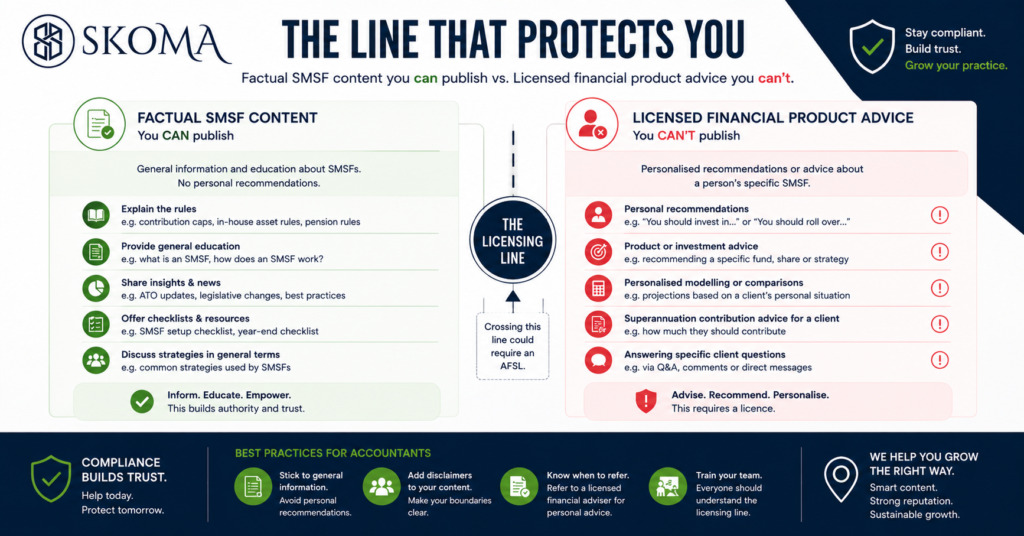
This is the section generic guides skip, and it matters. Two boundaries shape what an accounting firm can publish.
- Financial product and SMSF advice requires a licence. The “accountants’ exemption” (Regulation 7.1.29A) was repealed on 1 July 2016. Since then, advice about acquiring or disposing of an interest in an SMSF — including recommending that a client set up or wind up a fund — is financial product advice, and an accountant must hold or be authorised under an Australian Financial Services (AFS) licence to give it. That extends to content: a web page that could reasonably be seen as intended to influence someone’s decision to establish an SMSF or acquire a financial product may cross the line. CPA Australia notes that unlicensed financial product advice can attract significant penalties and won’t be covered by professional indemnity insurance.
What this means practically for your content:
- Factual and educational is generally fine — explaining what an SMSF is, how administration works, or what the super rules are.
- Recommendations are not — content steering a reader toward setting up an SMSF or a particular product is licensed territory.
- When in doubt, keep it general and factual, add a clear “general information only” statement, and route product decisions to a licensed adviser or your AFS licensee.
- Advertising must not be false or misleading. Registered tax agents are bound by the Tax Practitioners Board’s Code of Professional Conduct, and members of CPA Australia, Chartered Accountants ANZ and the IPA have professional-conduct standards. In plain terms: don’t overstate outcomes, guarantee refunds, or make claims you can’t substantiate.
None of this is a reason to publish less — it’s a reason to publish credibly. Firms that get the expertise and the compliance right build exactly the trust that YMYL topics reward. (This is general guidance, not legal or compliance advice — confirm your obligations with ASIC’s INFO 216, your AFS licensee and your professional body.)
Trust, Reviews and E-E-A-T for Accountants
Because accounting is a trust-first, YMYL category, credibility signals do heavy lifting.
- Show your credentials and memberships. Registered tax agent number, CPA/CA/IPA membership, and named advisers with real bios and qualifications all signal expertise and experience — the “E-E-A-T” Google looks for.
- Build a steady flow of Google reviews. Ask satisfied clients after a milestone (a completed return, a successful advisory engagement). Respond professionally to every review, and never discuss a client’s confidential details publicly.
- Publish genuinely expert content with author attribution, so both readers and search engines can see who stands behind the advice.
- Keep NAP consistent — your Name, Address and Phone identical across your website, Google Business Profile and directories, and list in reputable Australian and industry directories.
Measuring What Matters
Track client enquiries, not vanity rankings. Connect your Google Business Profile, Google Search Console and a clean analytics setup so you can see which searches, pages and services actually generate calls, form submissions and booked consultations. Because client value varies so much by service, segment your reporting — an SMSF-administration enquiry and a one-off tax-return enquiry shouldn’t be counted the same way. If you can’t tell which content wins the clients worth having, you can’t invest with confidence.
Common Mistakes
- Competing only on “accountant [city]” and ignoring the easier, higher-value niche terms.
- A single “services” page instead of a dedicated page per service.
- Thin, duplicated location pages built only to capture suburb names.
- Publishing SMSF or financial-product content that strays into licensed advice without an AFS licence.
- Overstated marketing claims (guaranteed refunds, “biggest return”) that breach professional-conduct rules.
- Ignoring the financial-year calendar, then publishing tax-time content after the search spike.
- No visible credentials or author bios, weakening trust on a YMYL topic.
- Set-and-forget — not refreshing seasonal content each year as rules and thresholds change.
Frequently Asked Questions
How much does SEO cost for an accounting firm in Australia? Most firms invest in an ongoing monthly programme rather than a one-off project, commonly in the $1,500–$4,000/month range depending on competitiveness and how many services and niches you target. Because client lifetime value is high, it often pays back on a small number of the right enquiries. See our guide on how much SEO costs in Australia.
How long does SEO take to work for accountants? Expect early movement on niche and lower-competition terms within one to three months, and competitive “accountant [suburb]” terms to build over several months. Seasonal content also compounds — an EOFY guide published this year strengthens each year it’s refreshed.
Can I write about SMSFs on my website without an AFS licence? You can publish factual, educational information about SMSFs. What you cannot do without an AFS licence (or authorisation under one) is give advice recommending someone set up, wind up, or acquire/dispose of an interest in an SMSF or financial product — the accountants’ exemption was repealed in 2016. Keep unlicensed content general, add a “general information only” note, and check ASIC’s INFO 216 and your licensee if unsure.
What’s the best SEO strategy for a small accounting firm? Start with your Google Business Profile and a clear page for each core service, then add one or two niche pages for the industries where you already have clients. Layer in seasonal content around the financial-year calendar. That sequence delivers the fastest, best-fit enquiries.
Should my firm target a niche or stay a generalist? Niche specialisation is usually the faster SEO win and attracts higher-value clients. You can rank for “accountant for tradies” or “ecommerce accountant” far more easily than broad city terms, and speak directly to that client’s situation.
Do online reviews really affect my ranking? Yes — reviews contribute to the “prominence” Google uses for local ranking, and they heavily influence whether a prospect chooses you. Ask happy clients consistently, and respond to every review professionally.
Conclusion
For an Australian accounting firm, SEO done well is a client-quality engine, not a traffic exercise. Build a website structured around your services, locations and — most powerfully — the industries you specialise in. Run a content programme that follows the financial-year calendar so you’re visible before each search spike. Back it with genuine expertise, visible credentials and steady reviews. And respect the licensing line that governs financial-product and SMSF content, which turns compliance into a trust advantage rather than a risk.
Do that consistently, and you won’t just rank — you’ll attract the higher-value clients that make a practice genuinely more profitable.
Want to see where your firm stands? SKOMA Digital will run a free SEO review of your accounting practice — your Google Business Profile, site structure and content — and map the fastest, compliant path to more of the clients worth having. No jargon, no obligation.
About SKOMA Digital
SKOMA Digital is an Australian digital marketing consultancy providing senior, measurement-first SEO and growth strategy for professional-services firms, local businesses and direct-to-consumer brands. For accounting and finance clients, our work pairs local and industry SEO with an understanding of the sector’s seasonal demand and compliance environment — and we report on client enquiries and revenue, not vanity metrics.
Author
Written by the SKOMA Digital editorial team, reviewed by Sami Khan, Founder. Sami has 13+ years in digital marketing and has led performance programmes for professional-services and consumer brands. SKOMA’s editorial standard is evidence-led: regulatory points here are grounded in ASIC and professional-body guidance, and financial-year dates in the ATO’s published calendar.
Disclaimer
This article is general information for Australian accounting and bookkeeping firms about marketing and SEO. It is not legal, financial, tax or compliance advice. Licensing obligations for SMSF and financial-product advice are set by ASIC under the Corporations Act; professional-conduct and advertising obligations are set by the Tax Practitioners Board and the professional bodies (CPA Australia, CA ANZ, IPA). Financial-year dates and thresholds change; confirm current dates with the ATO and your obligations with ASIC (INFO 216), your AFS licensee and your professional association before publishing regulated content.
References
- ASIC — AFS licensing requirements for accountants who provide SMSF services (INFO 216; repeal of the accountants’ exemption, 1 July 2016).
- CPA Australia — Regulation of SMSF advice.
- Australian Taxation Office — key lodgement and due dates (BAS, FBT, individual returns, super, STP, TPAR).
- Tax Practitioners Board — Code of Professional Conduct (advertising must not be false or misleading).
- Google Business Profile Help — Tips to improve your local ranking on Google.
- Google Search Central — Creating helpful, reliable, people-first content (E-E-A-T, YMYL).