
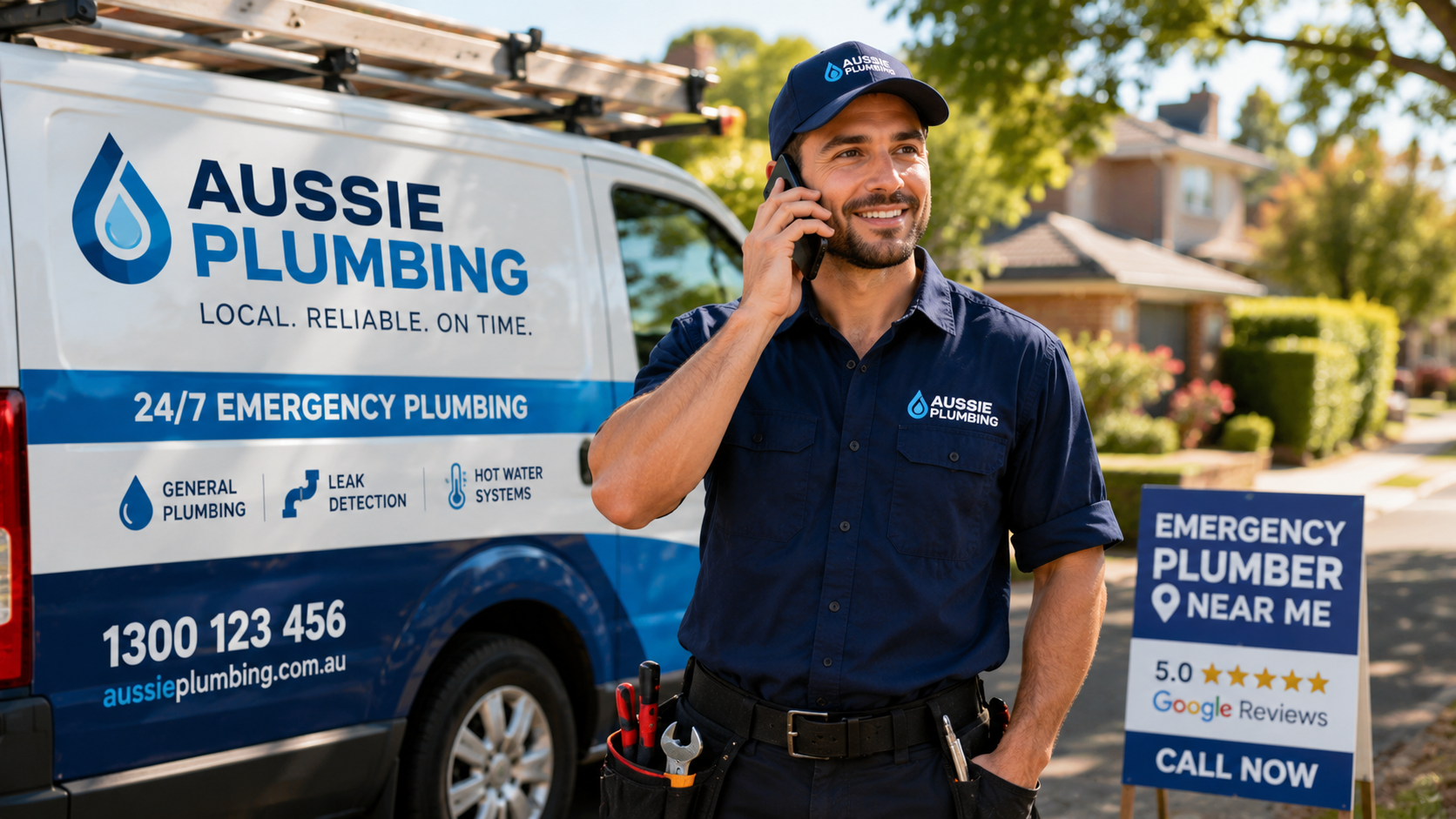
Quick Summary
- Plumbing search splits in two: urgent emergencies (burst pipe, blocked drain, no hot water) and planned jobs (hot water replacement, bathroom renovations). They need different pages and different tactics.
- Emergency intent is where the money is. “Emergency plumber near me” carries some of the highest commercial value in the trade, and the plumber who’s visible and answers the phone wins the job.
- Speed of response beats everything on emergency jobs. A dedicated 24/7 page, tap-to-call on every screen, and someone actually picking up convert far better than a prettier website.
- Win planned jobs with service pages. “Hot water system replacement” and “drain cleaning” are big, lower-urgency searches you capture with clear, informative pages.
- Structure around services × suburbs. A page per key service, crossed with the areas you cover, is the backbone of plumbing SEO.
- Reviews and your licence build trust — people are letting a stranger into their home, often at night. Credibility signals close the call.
- This is a fast-win niche. With low keyword difficulty on the core term, a well-optimised plumbing business can see movement within one to two months.
This guide focuses on what’s specific to plumbers. For the trade-SEO fundamentals — setting up your Google Business Profile as a service-area business, reviews and the basics — start with our SEO for tradies pillar guide.
Table of Contents
- What is SEO for plumbers?
- The two searches every plumber must win
- Win the emergency searches (the money moment)
- Win the planned jobs
- Your services × suburbs architecture
- Licensing, gas work and trust signals
- Reviews: earning trust at 2am
- Seasonal demand and how to plan for it
- Measuring what actually books jobs
- Common plumbing SEO mistakes
- Frequently asked questions
What Is SEO for Plumbers?
SEO for plumbers is the work that puts a plumbing business in front of local customers at the exact moment they search for help — whether that’s a panicked emergency plumber near me at midnight or a considered hot water system replacement on a Sunday afternoon. It means optimising your Google Business Profile, website and reviews so you appear in the local map results and organic listings for the searches that turn into booked jobs.
What makes plumbing different from most trades is the urgency split. Some of your customers have water pouring through a ceiling and will call the first credible plumber they see. Others are planning a job and comparing options over days. Winning both means understanding that they search differently — and building for each.
The Two Searches Every Plumber Must Win
Australian plumbing search demand divides cleanly into two intents. The figures below are indicative Australian monthly search volumes (via Semrush) — they show where the demand and the commercial value sit.
Emergency intent — the customer needs help now:
| Search | AU monthly volume | Commercial value (CPC) |
| plumber near me | ~22,200 | $14.17 |
| emergency plumber | ~8,100 | $14.47 |
| emergency plumber near me | ~3,600 | $18.62 (highest) |
| blocked drain | ~3,600 | $12.22 |
| 24 hour plumber | ~1,300 | $13.85 |
| burst pipe | ~720 | $9.49 |
Planned intent — the customer is researching or scheduling:
| Search | AU monthly volume | Commercial value (CPC) |
| hot water system replacement | ~4,400 | $7.63 |
| leak detection | ~3,600 | $10.08 |
| drain cleaning | ~1,600 | $9.34 |
| gas fitter | ~1,600 | $7.08 |
| hot water repair | ~1,300 | $13.40 |
The lesson is clear: emergency terms carry the highest commercial value (note “emergency plumber near me” at $18.62 — advertisers pay that because those searchers convert). But planned jobs like hot water replacement are large, less competitive at the moment of search, and often higher-value per job. A complete plumbing SEO strategy targets both — with different pages built for each.
Win the Emergency Searches (the Money Moment)
When someone searches “emergency plumber near me”, they are not reading your About page. They are scanning for a plumber who is close, credible and reachable right now. Three things win that job.
- A dedicated emergency / 24-7 page. Don’t bury emergency service in a paragraph on your homepage. Build a page targeting the intent directly — /emergency-plumber — that states your availability, response time and coverage area up front. This gives Google a clear page to rank for urgent queries and gives the panicked customer an instant answer.
- Tap-to-call on every screen. Your phone number must be tappable, prominent and ideally fixed to the top or bottom of the screen on mobile — because nearly all emergency searches happen on a phone. Every extra tap between the search and the call costs you the job.
- Answer the phone — and say so. The plumber who is visible and picks up beats the one who is slightly higher ranked but goes to voicemail. Make your availability explicit (“24/7”, “on-site within the hour where possible”), and if you can, use call tracking so you know which searches and pages generate calls. Being findable is only half the battle; being reachable closes it.
Speed matters technically too. A slow-loading site on a patchy mobile connection loses an impatient customer before your page even appears. Fast, mobile-first pages are non-negotiable for emergency intent.
Win the Planned Jobs
Planned searches — hot water replacement, bathroom rough-ins, drain cleaning, leak detection — are a different game. Here the customer has time to compare, so you win with clear, informative service pages that answer their questions and build confidence.
- Give each major service its own page. A dedicated “hot water system replacement” page — covering gas vs electric vs heat pump, typical costs, how long it takes, and your process — will outrank a generic services list and pre-qualify the enquiry.
- Answer the money questions. Planned-job searchers want to know indicative cost, timeframe and what’s involved. Content that answers those honestly earns trust and increasingly appears in Google’s AI Overviews.
- Show your work. Real photos of completed jobs, brands you install, and any warranties reassure a customer choosing between quotes.
Planned-job content also does double duty: it’s the material that earns links and topical authority, which lifts your whole site — including those competitive emergency terms.
Your Services × Suburbs Architecture
The backbone of plumbing SEO is a matrix: a page for each key service, and pages for the key areas you cover.
| Page type | Purpose | Example URL |
| Emergency page | Capture urgent “emergency / 24 hour” intent | /emergency-plumber |
| Service page (one per service) | Rank for planned-job searches | /services/hot-water-systems |
| Service-area page (per key suburb) | Rank for “plumber [suburb]” | /areas/[suburb] |
| Educational article | Answer questions; build authority | /blog/why-is-my-drain-blocked |
| Contact / booking | Convert; tap-to-call and quote form | /contact |
A few rules keep this working:
- One page, one job. Separate pages for blocked drains, hot water, gas fitting, leak detection and drain cleaning — not one “services” page listing them all.
- Avoid thin, duplicated suburb pages. Ten near-identical “plumber in [suburb]” pages with only the name changed are treated as low value. Each area page needs genuinely local content — response times, local jobs, areas covered.
- Point your Google Business Profile at the most relevant service or area page, not just the homepage.
Licensing, Gas Work and Trust Signals
Plumbing is a licensed, safety-critical trade, and Google (like your customers) rewards clear signals that you’re legitimate.
- Display your plumbing licence number. In most states, licensed trades must show their licence number on advertising — and your website and Google Business Profile count as advertising. Requirements vary by state, so check your authority (for example NSW Fair Trading, the VBA in Victoria, or the QBCC in Queensland). It’s also a simple trust signal that wins the toss-up between two similar plumbers.
- Note gas work separately. Gas fitting is a separately licensed activity in Australia. If you’re licensed for gas, say so clearly — “gas fitter” is a distinct, valuable search (around 1,600 monthly searches) and a service many general plumbers can’t legally offer.
- Show insurance and your ABN. Public liability cover and a registered ABN reassure customers and support later verification for ads or marketplaces.
(This is general guidance — confirm your specific licensing and advertising obligations with your state authority.)
Reviews: Earning Trust at 2am
Reviews matter for every trade, but they carry extra weight for plumbers, because the customer is inviting a stranger into their home — often in a crisis, often after dark. A plumber with 100 recent, genuine reviews wins the emergency call over one with six.
- Ask every customer, every job — a text with a review link once you’ve packed up.
- Aim for a steady flow, not a one-off burst; recency signals an active, trusted business.
- Respond to every review, calmly and professionally, without discussing private details.
- Never buy or incentivise reviews — it breaches Google’s policies and risks your profile.
Seasonal Demand and How to Plan For It
Plumbing demand is seasonal, and you can publish and refresh content ahead of each spike:
- Winter drives hot water failures and replacements — have your hot water pages sharp before the cold hits.
- Wet season and storms drive blocked drains, flooding and stormwater issues — timely content and readiness capture the surge.
- Renovation seasons (often spring) lift planned bathroom and kitchen plumbing searches.
Getting your relevant pages strong before the seasonal peak means you’re ranking when the demand arrives, not scrambling after it.
Measuring What Actually Books Jobs
Judge your plumbing SEO by booked jobs, not rankings:
- Calls — from your Google Business Profile insights and, ideally, call tracking that ties calls back to pages and searches.
- Which services and suburbs convert — so you invest where the profitable jobs are (an emergency call-out and a tap-washer replacement are not equal).
- Form and quote requests — from a clean analytics setup.
- Direction requests — a strong local-intent signal from your profile.
If you can see calls and quote requests rising, you’re winning — regardless of where a single keyword sits on a given day.
Common Plumbing SEO Mistakes
- No dedicated emergency page, so urgent searches have nowhere to land.
- Phone number buried instead of tap-to-call on every screen.
- One “services” page instead of a page per service.
- Ignoring planned-job terms like hot water replacement that bring high-value work.
- Thin, duplicated suburb pages.
- No licence number displayed, weakening trust and compliance.
- Slow, non-mobile site that loses impatient emergency searchers.
- Not asking for reviews consistently.
- Relying only on rented leads from marketplaces instead of building owned visibility.
Frequently Asked Questions
How do plumbers get more leads from Google? By ranking in the local map pack and organic results for the searches customers actually use — “emergency plumber near me”, “blocked drain [suburb]”, “hot water replacement”. That means an optimised Google Business Profile, a dedicated emergency page, service pages for planned jobs, steady reviews, and a fast, tap-to-call website.
What’s the most valuable search for a plumber? Emergency and “near me” terms carry the highest commercial value — “emergency plumber near me” is among the most valuable in the trade. But planned jobs like hot water replacement are large and often higher-value per job, so target both.
Do I need a separate page for emergency plumbing? Yes. A dedicated 24/7 emergency page gives Google a clear page to rank for urgent searches and gives a panicked customer an instant answer with your availability and phone number front and centre.
How long does SEO take for a plumbing business? Because the core term is low-competition, a well-optimised plumbing business can see early movement within one to two months, with competitive suburb and emergency terms building over several months.
How much does SEO cost for a plumber? Local plumbing SEO typically sits at the lower end of the market — often around 1,000–2,000 per month for ongoing work. Given the value of a single emergency call-out or hot water job, it usually pays for itself quickly. See our guide on how much SEO costs in Australia.
Should I do Google Ads as well? For emergency work, many plumbers run both — ads for instant visibility on high-intent terms while SEO builds. The advantage of SEO is that it keeps working after you stop paying, lowering your cost per job over time.
Is it worth listing on hipages or Oneflare? They can be a useful top-up, but the leads are shared, you pay per contact, and you never own the customer. SEO builds an asset you keep. Use marketplaces to fill gaps while you build owned visibility — see our SEO for tradies guide.
Conclusion
Plumbing is one of the best trades for SEO, because the searches are high-intent, high-value and, on the core terms, very winnable. The plumbers who dominate their area do three things well: they capture emergency intent with a dedicated 24/7 page, tap-to-call everywhere and a phone that gets answered; they win planned jobs with clear service pages that answer the cost and process questions; and they back it all with genuine reviews and a visible licence.
Build for both the midnight burst pipe and the planned hot water replacement, structure your site around services and suburbs, and measure booked jobs rather than rankings. Do that, and you’ll turn more of those searches into the calls that pay the bills.
Want more emergency calls and booked jobs? SKOMA Digital will run a free local-search check on your plumbing business — your Google Business Profile, emergency page and reviews — and show you the fastest way to rank for the searches that convert. No jargon, no obligation.
About SKOMA Digital
SKOMA Digital is an Australian digital marketing consultancy providing senior, measurement-first SEO and growth strategy for trade and service businesses, professional-services firms and direct-to-consumer brands. We help trades build an owned pipeline of enquiries rather than renting leads — and we report on calls and jobs won, not vanity metrics.
Author
Written by the SKOMA Digital editorial team, reviewed by Sami Khan, Founder. Sami has 13+ years in digital marketing and has led performance programmes for local operators and national brands. SKOMA’s editorial standard is evidence-led: search-demand figures here are drawn from Semrush’s Australian database, and recommendations from Google’s own guidance.
Disclaimer
This article is general information for Australian plumbing businesses and is not legal advice. Trade and gas licensing and advertising requirements — including the obligation to display a licence number — vary by state, territory and activity; confirm your obligations with your relevant licensing authority (for example NSW Fair Trading, VBA, QBCC or your state equivalent). Search volumes are indicative and drawn from Semrush’s Australian database at the time of writing; figures change over time.
References
- Semrush — Australian keyword database (search volume, difficulty and CPC for plumbing terms).
- Google Business Profile Help — Tips to improve your local ranking on Google (relevance, distance, prominence).
- Google Business Profile Help — Manage your service areas (service-area business setup).
- Google Search Central — Spam policies (keyword stuffing, fake reviews).
- State licensing authorities — NSW Fair Trading; Victorian Building Authority (VBA); Queensland Building and Construction Commission (QBCC), for plumbing and gas licence-display requirements.