
Quick Summary
-
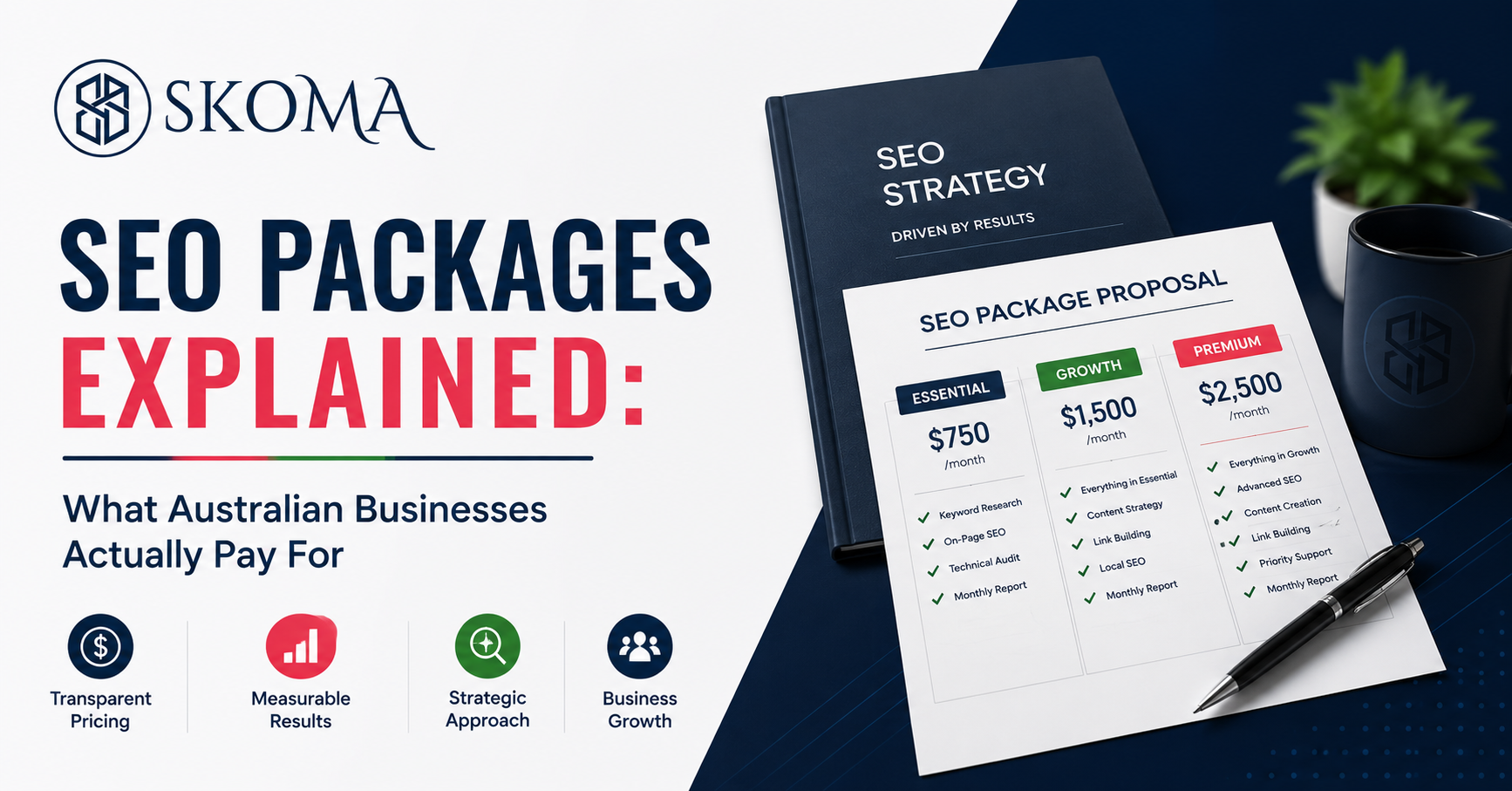
An SEO package is a bundle of recurring deliverables sold as a fixed monthly fee. The label (“basic”, “growth”, “enterprise”) means nothing on its own — the inclusions and the hours behind them are what you’re buying.
-
Retainers dominate the market. In Ahrefs’ global survey of 439 SEO providers, 78.2% bill on a monthly retainer, well ahead of per-project (48.9%) and hourly (34.8%). Note these are global, USD figures — Australian pricing sits differently.
-
In Australia, most SMB retainers land between roughly $1,500 and $5,000 per month, with published entry-level pricing averaging around $1,500. Competitive verticals (legal, finance, dental, national ecommerce) push higher.
-
Every package resolves into one thing: hours. At a typical Australian agency rate of $150–$250/hour, a $3,000 retainer buys roughly 12–20 hours of senior time. If the hour maths doesn’t add up, the results won’t either.
-
Six standard components appear in nearly every legitimate retainer: strategy, technical SEO, content, on-page optimisation, authority building (links/digital PR) and reporting. Local SEO is added where relevant.
-
Compare on scope and hours, never on the headline number. A $2,000 package with clear deliverables can outperform a $4,000 one that’s mostly automated reporting.
-
Sub-$800/month retainers rarely fund real work. After tools and overheads, there is little time left for anything meaningful.
Table of Contents
- What is an SEO package?
- Why agencies sell packages at all
- The three pricing models you’ll be quoted
- What’s actually inside an SEO package
- The three tiers, decoded
- The hours maths: how to compare two proposals fairly
- What each budget level realistically buys
- Red flags and green flags in an SEO proposal
- Are packages even the right way to buy SEO?
- Frequently asked questions
What Is an SEO Package?
An SEO package is a bundle of recurring search-optimisation deliverables — typically strategy, technical fixes, content, link acquisition and reporting — sold as a fixed monthly fee. Most Australian agencies present two to four tiers, commonly labelled something like basic, growth and enterprise.
The important thing to understand up front is that these labels are marketing, not standards. There is no industry body defining what a “growth package” must contain. One agency’s $2,500 growth tier may include four articles, a technical retainer and genuine link outreach. Another’s may include an automated report, two AI-written blog posts and a directory submission. Both are legally “SEO packages”. Only one is worth the money.
This guide exists to make the inside of the box visible, so you can compare proposals on what actually gets done.
Why Agencies Sell Packages at All
Packages are not inherently a bad thing — they exist for defensible reasons.
- SEO compounds. Rankings improve through sustained technical, content and authority work, not a one-off burst. A recurring fee funds recurring work.
- They simplify buying. Tiers give a buyer a starting point without a two-week discovery process.
- They stabilise both sides. Retainer-based agencies show markedly lower client churn than project-based ones, which usually means longer, more strategic engagements rather than a series of disconnected tasks.
The problem is not the package model. The problem is the opaque package — a headline price with vague inclusions, sold before anyone has looked at your website. A price set before an audit is a package sale, not a strategy.
The Three Pricing Models You’ll Be Quoted
| Model | Typical Australian range | Best suited to | Main limitation |
| Monthly retainer | ~$1,500–$5,000+/month (SMB); higher in competitive verticals | Ongoing growth where work must compound | Scope can blur if deliverables aren’t written down |
| Project / one-off | Audit ~$2,000–$10,000; migration ~$3,000–$10,000+ | A bounded problem: audit, migration, strategy document | An audit diagnoses; it doesn’t fix anything |
| Hourly consulting | ~$150–$350/hour | Teams who can implement recommendations themselves | Advice without execution becomes a backlog |
A fourth model, performance-based pricing (“pay only when you rank”), is worth naming so you can avoid it. It sounds risk-free, but it incentivises the provider to chase the easiest keywords rather than the commercially valuable ones — and occasionally to use tactics that trade your site’s long-term health for a short-term invoice.
For a full breakdown of price bands by business type, see our companion guide on how much SEO costs in Australia.
What’s Actually Inside an SEO Package
Strip away the branding and nearly every legitimate retainer stacks the same six components. When you compare proposals, compare them component by component.
- Strategy and senior review — someone experienced deciding what to work on next month and reviewing what worked last month. Usually 2–4 hours. This is the line item cheap packages delete first, and it’s the one that determines whether the other hours are spent well.
- Technical SEO — crawl and indexation health, site speed, structured data, redirect logic, fixing regressions before they cost you rankings.
- Content — briefs, writing, and optimising or consolidating existing pages. Ask how many pieces, at what length, and who writes them.
- On-page optimisation — titles, meta descriptions, headings, internal linking and schema across priority pages.
- Authority building — earning links and brand mentions through digital PR, partnerships and outreach. Ask how links are sourced. “Hundreds of backlinks” with no stated methodology is a link scheme.
- Reporting and analytics — a genuine monthly read of what happened and why. Real reporting takes a few hours; an automated PDF takes none.
Where relevant, a seventh component is added:
- Local SEO — Google Business Profile management, citations, review systems and location pages. Essential for clinics, tradies, hospitality and any multi-location business.
Increasingly, a modern retainer also folds in AI search visibility (appearing in AI Overviews and assistants like ChatGPT and Perplexity). Treat this as part of one organic engine, not a separate mystery line item. If a proposal bills “GEO” separately without defining the work, ask what specifically changes on your site.
The Three Tiers, Decoded
Here is what the common tiers typically contain in the Australian market. Use this as a translation table, not a price list — the ranges shift with your industry’s competitiveness.
| Basic / Starter | Growth / Standard | Enterprise / Premium | |
| Typical AU monthly fee | ~$800–$1,500 | ~$1,500–$4,000 | ~$4,000–$10,000+ |
| Rough hours bought | ~5–9 | ~10–22 | ~25–50+ |
| Strategy input | Minimal; templated plan | Monthly senior review | Dedicated strategist, quarterly roadmap |
| Technical SEO | Basic fixes, monitoring | Ongoing maintenance + fixes | Deep technical, dev collaboration, migrations |
| Content | 1–2 pieces or optimisation only | 2–4 pieces + existing-page updates | Full content programme, briefs, subject-matter input |
| Authority building | Citations / directories only | Genuine outreach, modest volume | Digital PR campaigns, data-led assets |
| Local SEO | GBP basics | GBP + citations + reviews | Multi-location at scale |
| Reporting | Automated dashboard | Reviewed report + commentary | Custom reporting tied to revenue |
| Best for | Single-location, low-competition niches | Most Australian SMBs | Competitive verticals, ecommerce, multi-location |
The honest read: most Australian small and medium businesses need the middle tier to see meaningful movement. The basic tier is best understood as maintenance — keeping foundations healthy — rather than growth.
The Hours Maths: How to Compare Two Proposals Fairly
This is the single most useful thing in this article, and almost no agency volunteers it.
Every package, however it’s dressed up, converts into hours of skilled time. So do the arithmetic before you sign:
Monthly fee ÷ hourly rate ≈ hours of work you’re buying.
At a typical Australian agency rate of $150–$250 per hour:
| Monthly fee | Approximate hours | What that realistically funds |
| $800 | 3–5 | Light maintenance. Not a growth programme. |
| $1,500 | 6–10 | Foundations, some content or some technical — rarely both well. |
| $3,000 | 12–20 | Strategy + technical + content + modest authority work. |
| $5,000 | 20–33 | Genuine multi-discipline programme with senior input. |
| $10,000+ | 40+ | Competitive verticals, ecommerce, or multi-location at scale. |
Now apply the test. If a proposal quotes $900/month and promises a technical audit, eight blog articles, twenty backlinks and monthly reporting, ask how many hours that represents. It cannot be done in the three-to-five hours the fee funds. The work is either automated, offshored, templated, or simply not happening.
The same test rescues the opposite case. A $2,000 proposal with fewer deliverables but a named senior strategist and clear hours may be a far better buy than a $3,500 proposal listing twenty vague line items.
There’s a floor worth naming. Below roughly $800 per month, once tools (Semrush or Ahrefs alone run into the hundreds monthly), project management and overheads are covered, very little skilled time remains. If that’s genuinely your ceiling right now, you are usually better off buying a one-off audit and implementing the fixes yourself — or spending the money improving conversion on the traffic you already have.
What Each Budget Level Realistically Buys
Work backwards from customer value, not forwards from the cheapest quote.
- A business whose average customer is worth $2,000 needs only a handful of extra enquiries a month for a $1,500 retainer to pay for itself.
- A practice selling $6,000 implant cases or a firm winning $15,000 matters can justify a far larger programme on a single additional client.
- An ecommerce store turning over $80,000/month can justify enterprise budgets on single-digit percentage gains.
A useful rule of thumb: if professional SEO cannot plausibly pay for itself within twelve months from the customers it wins you, either the quote is wrong for your business size, or SEO is not your next best investment. An honest agency will tell you which.
Two other levers move your number more than your postcode does:
- Competition in your industry. Ranking a mobile dog groomer in a regional town and ranking a compensation lawyer in a capital city are different jobs. Industry sets the floor for what effective SEO costs.
- The state of your website. A slow, thin or broken site needs remedial technical work before growth work can compound — and that work has to be paid for.
Red Flags and Green Flags in an SEO Proposal
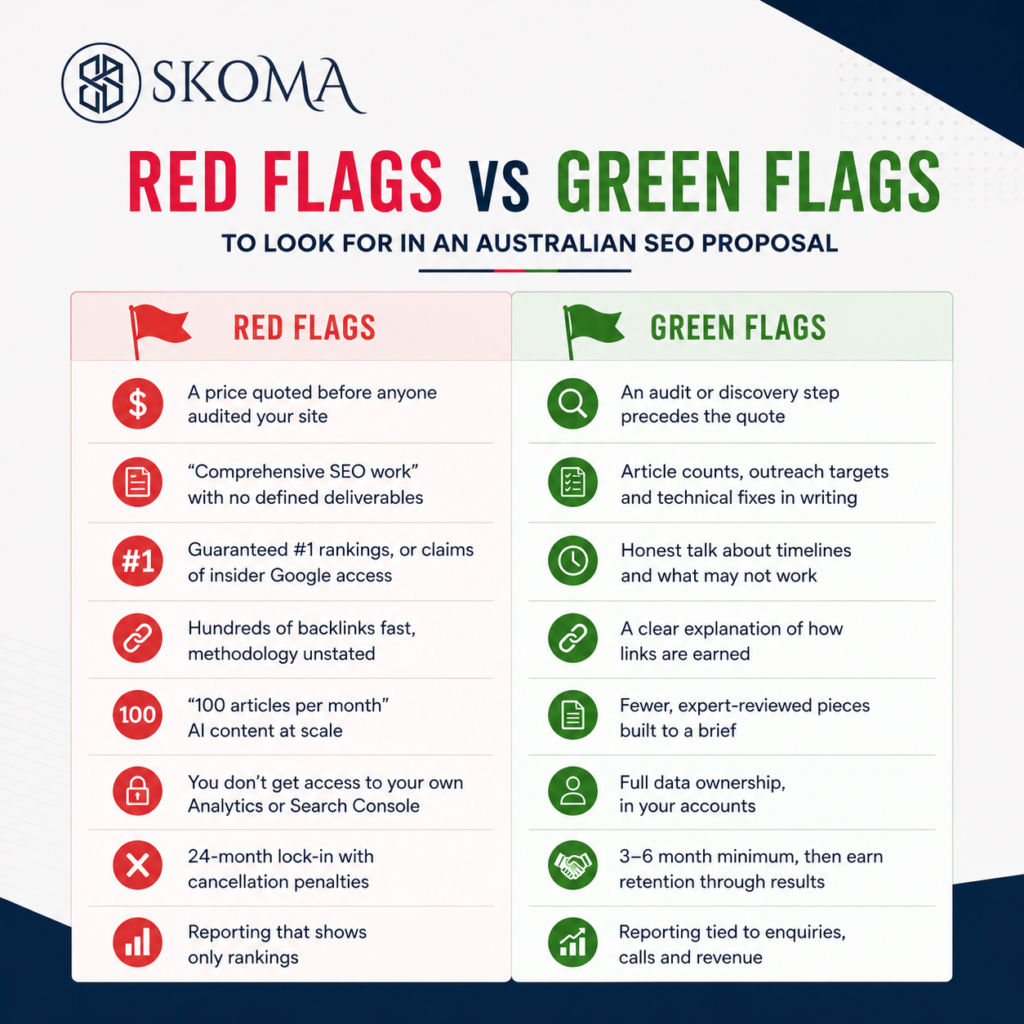
Data ownership deserves emphasis. Your Google Analytics and Google Search Console accounts belong to you. An agency that withholds them is holding your evidence hostage, and it makes switching providers — or even evaluating one — nearly impossible.
Are Packages Even the Right Way to Buy SEO?
Sometimes. A productised package genuinely suits a business with a simple site, a single location and a well-understood competitive set. The scope is predictable, so a fixed price is fair to both sides.
But packages fail in the exact situation most businesses are actually in: a site with some technical debt, a handful of commercially valuable pages, and a competitor set that varies by service line. In that case a tier chosen from a pricing page is a guess. The alternative is straightforward — a short diagnostic first, then a scope built from what it finds.
That’s the approach we take at SKOMA Digital. We sequence the work rather than bundle it: measurement and technical foundations before acquisition, because every downstream decision depends on those being trustworthy. Then we report on enquiries and revenue rather than rankings alone. The point isn’t to sell a bigger package — it’s to make sure the hours you buy go where they compound.
Frequently Asked Questions
How much do SEO packages cost in Australia? Most Australian SMB retainers sit between roughly $1,500 and $5,000 per month, with published entry-level pricing averaging around $1,500/month. Competitive verticals such as legal, finance, dental and national ecommerce commonly push past $5,000. Note that widely-quoted survey averages (like Ahrefs’ $3,209 agency figure) are global and in USD — useful for direction, not for budgeting an Australian engagement.
What should be included in an SEO package? At minimum: strategy and senior review, technical SEO, content, on-page optimisation, authority building, and genuine reporting. Local businesses should also see Google Business Profile management, citations and review systems. If any of these are missing, ask why.
Is a cheap SEO package worth it? Below about $800/month, be honest about what you’re buying. After tools and overheads there are only a few hours of work left — usually automated, templated or offshored. That money is often better spent on a one-off audit you implement yourself, or on improving conversion for the traffic you already have.
Why do agencies hide their pricing? Partly because scope genuinely varies, and partly because transparency invites comparison. Research auditing Australian agencies found the large majority publish no pricing at all. Scope-based quoting is legitimate; refusing to explain what drives the number is not.
Are monthly retainers better than one-off projects? For ongoing growth, yes — search is a moving target, so consistent work compounds. Projects suit bounded problems: an audit, a migration, a strategy document. The classic trap is buying an audit with nobody to implement it. A beautifully documented problem is still a problem.
How many hours should my retainer include? Divide the fee by an hourly rate of $150–$250. A $3,000 retainer should represent roughly 12–20 hours of skilled time. Any agency unwilling to discuss this is asking you to trust a black box.
Do I need a separate package for AI search visibility? Usually not. The signals that build organic authority — expertise, structure, evidence, technical accessibility — are largely the same ones that earn citations in AI Overviews and assistants. Treat AI visibility as part of one organic engine, and be sceptical of a separate line item that can’t describe what it actually changes.
Conclusion
The word “package” implies a standard product, and that’s exactly the misunderstanding it trades on. What you are really buying is a number of hours of skilled attention, directed at the right problems in the right order. Two proposals at the same price can differ tenfold in value, and the only reliable way to tell them apart is to open the box: ask what gets done, by whom, how many hours it represents, and how the results will be measured.
Buy on scope and hours. Insist on owning your data. Work backwards from what a customer is worth to you. Do those three things and you will rarely overpay — regardless of which tier the pricing page recommends.
Call to Action
Comparing SEO proposals right now? SKOMA Digital will review the quotes on your desk — free of charge — and show you the hours, scope and gaps behind each one. No obligation, and we’ll tell you honestly if SEO isn’t your next best investment.
About SKOMA Digital
SKOMA Digital is an Australian digital marketing consultancy providing senior, measurement-first SEO and growth strategy to local businesses, professional-services firms and direct-to-consumer brands. We sequence engagements rather than bundle them — building the measurement and technical layer before acquisition — and we report on enquiries and revenue rather than vanity metrics. Our work spans technical SEO, local and industry SEO, content strategy, link building and analytics.
Author
Written by the SKOMA Digital editorial team, reviewed by Sami Khan, Founder. Sami has 13+ years in digital media and marketing, has overseen multi-million-dollar annual paid programmes for mid-to-large brands, and won the Semrush Award for Best Integrated Digital Campaign. SKOMA’s editorial standard is evidence-led: pricing claims here are drawn from published industry surveys and Australian market audits, and are labelled by currency and sample where they originate offshore.
Disclaimer
This article is general information for Australian businesses evaluating SEO services. It is not financial, accounting or legal advice, and it does not constitute a recommendation to engage any particular provider. All prices are indicative, quoted in Australian dollars and exclusive of GST unless stated, and were current at the time of writing; agency pricing changes frequently. Figures drawn from global surveys are denominated in USD and are noted as such. Always obtain a written scope of work before entering an agreement.
References
- Ahrefs — SEO Pricing: How Much Does SEO Cost? (survey of 439 SEO service providers). Global data, USD. https://ahrefs.com/blog/seo-pricing/
- Ahrefs — SEO Statistics (pricing-model distribution: 78.2% monthly retainer). https://ahrefs.com/blog/seo-statistics/
- Australian agency pricing audits and published price lists (Australian Digital Marketing Price Index, 2026), for entry-level and median AU retainer benchmarks.
- Google Search Central — Spam policies for Google web search (on link schemes and scaled content abuse). https://developers.google.com/search/docs/essentials/spam-policies
- Google Search Central — Creating helpful, reliable, people-first content. https://developers.google.com/search/docs/fundamentals/creating-helpful-content
- Google Search Console and Google Analytics — official documentation on account ownership and access.