Quick Summary
-
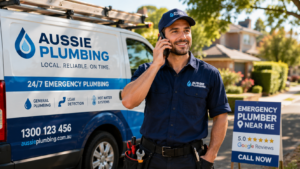
For a tradie, SEO is mostly local SEO. The job is to appear in Google’s local “map pack” and Maps when nearby customers search “[trade] near me” or “emergency [trade] [suburb]”.
-
Your Google Business Profile is the biggest lever. Set it up correctly as a service-area business: hide your home address, list the suburbs you actually cover, and pick the right primary category.
-
Own your leads instead of renting them. A ranked profile and website generate enquiries you keep. Lead marketplaces like hipages, Oneflare and Airtasker rent you shared leads that stop the day you stop paying.
-
Reviews are the trust engine. Steady, genuine Google reviews drive both your ranking (prominence) and your call rate. Ask every happy customer.
-
Show your licence number. In most states, licensed trades must display their licence number on advertising — including your profile and website. It’s also a powerful trust signal.
-
Structure beats volume. A clear set of service pages and genuine service-area pages, plus a fast, click-to-call mobile site, converts searchers into phone calls.
-
Realistic timeline: early movement on low-competition and “near me” searches within one to three months; competitive suburb terms build over several months.
Table of Contents
-
What is SEO for tradies?
-
Why tradies can’t ignore Google anymore
-
Rent leads or own them? The real cost of hipages and mates
-
How Google decides which tradie shows up
-
Step 1 — Set up your Google Business Profile the right way
-
Step 2 — Get (and keep) genuine reviews
-
Step 3 — Build a website that turns searches into calls
-
Step 4 — Get listed everywhere your customers look
-
Trust signals: licences, insurance and real proof
-
What about “Google Guaranteed” and paid ads?
-
What results to expect (and how to measure them)
-
Common tradie SEO mistakes
-
Frequently asked questions
What Is SEO for Tradies?
SEO for tradies is the work that helps a trade business appear at the top of Google when nearby customers search for the services it offers. In practical terms, it means optimising your Google Business Profile, your website and your online reputation so you show up in the local map results and Maps for searches like plumber near me, emergency electrician [suburb] or fencing contractor [town].
Unlike a national online store, a tradie’s customers are almost always local and ready to act. Someone with a burst pipe or a dead hot-water system isn’t researching for next month — they want a nearby, trustworthy tradie who can come today. That high intent is exactly why ranking is so valuable: the tradie who shows up with photos, reviews and a tap-to-call button gets the job. The one who doesn’t, doesn’t exist to that customer.
Why Tradies Can’t Ignore Google Anymore
The way people find a tradie has changed completely. Word of mouth still matters, but when a mate can’t recommend someone, the next step is a phone in hand and a Google search. Google holds roughly 89–90% of the Australian search market, and a huge share of local searches on a phone lead to a call or a visit within a day.
Two things follow from that. First, if you’re not visible in local search, you’re invisible at the exact moment a customer is choosing who to call. Second, most of your competitors are getting this wrong — a profile they set up years ago and forgot, no recent photos, a handful of reviews. That gap is your opportunity. Doing local SEO properly puts you ahead of the large majority of trade businesses who never bothered.
Rent Leads or Own Them? The Real Cost of hipages and Mates
Plenty of tradies get their work from lead marketplaces — hipages, Oneflare, Airtasker, ServiceSeeking and similar. These can be a useful tap you turn on when you need work, but it’s worth understanding what you’re actually buying.
| Renting leads (marketplaces) | Owning leads (SEO + your profile) | |
| Who owns the customer | The platform | You |
| Lead exclusivity | Usually shared with several tradies | Yours alone |
| What you pay for | The contact (whether or not you win it) | An asset you build once |
| What happens if you stop paying | Leads stop that day | Rankings and reputation remain |
| Long-term cost per job | Tends to stay flat or rise | Falls as your visibility compounds |
Neither is “wrong”. The point is balance. Marketplaces build no asset you keep; your Google Business Profile, reviews and website do. The smartest tradies use marketplaces as a short-term top-up while they build an owned presence that steadily lowers their cost per job. This guide is about building that owned asset.
How Google Decides Which Tradie Shows Up
Google states publicly that local results are based primarily on three things: relevance, distance and prominence.
| Factor | What it means for a tradie | What you control |
| Relevance | How well your profile and site match the search (e.g. “roof repair”) | Your category, listed services, service areas and website content |
| Distance | How close you are to the searcher or the suburb in the query | Not directly — but accurate service areas and stronger prominence widen your reach |
| Prominence | How well-known and trusted you appear online | Reviews, citations, links, brand mentions and an active, complete profile |
Independent industry research (the Whitespark Local Search Ranking Factors survey) consistently attributes roughly a third of local-pack influence to Google Business Profile signals, about a fifth to reviews, and a meaningful slice to your website. The lesson for tradies is simple: your profile, your reviews and your website work together. Nail all three and you’re hard to beat locally.
Step 1 — Set Up Your Google Business Profile the Right Way
This is the single most important thing a tradie can do, and it’s free. Most tradies work out of a ute, not a shopfront, which makes you a service-area business (SAB) — and there’s a right way to set that up.
- Create or claim your profile at Google Business Profile, using your real business name, phone and (initially) your address for verification.
- Choose the correct primary category. This is one of your biggest relevance levers. A licensed plumber should be “Plumber”, not “Handyman” — the wrong category quietly costs you visibility. Add relevant additional categories (e.g. “Gas installation service”, “Drainage service”).
- Set yourself up as a service-area business. When asked whether customers visit you, select No, then hide your address and define the suburbs, towns or postcodes you actually service. Google allows up to 20 service areas.
- Keep your service areas realistic. Claiming to cover an entire state doesn’t help you rank further away — it just makes your profile look less specific. List the areas you can genuinely reach.
- Complete everything else. Services (with descriptions), hours, attributes, a keyword-natural business description, and 15–20 real photos of your team, vehicles, tools and finished jobs. Proof beats stock imagery every time.
- Pass verification. New service-area businesses are increasingly asked for video verification — a short, unedited clip on your phone showing your face, your branded vehicle or gear, and signage or materials linking you to the business, in one continuous take.
A few warnings that keep tradies out of trouble:
- Never use a PO box, virtual office or an address you can’t staff as a “ranking hack”. Listing a location customers can’t actually visit is a common cause of profile suspension.
- Hiding your address is correct for a true SAB, but be aware it can slightly affect how Google reads your proximity. That’s exactly why reviews, website content and local authority matter more for tradies than for shopfront businesses.
- Don’t stuff keywords into your business name. Only use your real, registered name — keyword-stuffed names breach Google’s guidelines and risk suspension.
For the full walkthrough, see our Google Business Profile optimisation guide.
Step 2 — Get (and Keep) Genuine Reviews
After your profile itself, reviews are the biggest driver of both ranking (prominence) and your call rate. Two tradies can rank side by side, and the one with 80 recent five-star reviews wins the call over the one with six.
- Ask every happy customer, every time. The easiest system is a short review link or a QR code you text after the job is done. Make it a habit, not an afterthought.
- Aim for a steady flow, not a one-off burst. Review recency and velocity matter — a trickle of fresh reviews signals an active, thriving business.
- Respond to every review, good or bad. A calm, professional reply to a negative review reassures the dozens of future customers reading it. Never get into a public slanging match.
- Never buy or incentivise reviews. Fake reviews breach Google’s policies and can get your profile penalised or removed.
Step 3 — Build a Website That Turns Searches Into Calls
Your profile gets you found; your website closes the deal and helps you rank for a wider set of searches. For a tradie, structure matters more than word count.
| Page type | Its job | Example |
| Homepage | Brand hub; who you are, service areas, trust signals | / |
| Service page (one per service) | Rank for service intent; explain the job | /services/hot-water-repairs |
| Service-area page (per key suburb/region) | Rank for “[trade] [suburb]”; carry local detail | /areas/[suburb] |
| Emergency / urgent page | Capture “emergency [trade]” intent | /emergency-plumber |
| Contact / quote | Convert; click-to-call and quote form | /contact |
Get these fundamentals right:
- Make it mobile-first and fast. Most tradie searches happen on a phone. A slow or clunky site loses the call.
- Put click-to-call everywhere. Your phone number should be tappable on every page, ideally in a sticky header.
- Give each service and key area its own page. A dedicated “hot water repairs” page will always outrank the same service buried in a paragraph on a general “services” page.
- Avoid thin, duplicated suburb pages. Ten near-identical pages with only the town name swapped are treated as low-value. Each service-area page needs genuinely local, useful content — the areas you cover, local jobs you’ve done, response times.
- Link your profile to the right page. Point your Google Business Profile at the most relevant service or area page, not just the homepage.
Step 4 — Get Listed Everywhere Your Customers Look
Beyond Google, consistency across the wider web builds trust and reinforces your location. This is your NAP — Name, Address (or service area) and Phone number.
- Keep your NAP identical everywhere — your website, Google Business Profile, social pages and directories. Inconsistency (an old number here, a different business name there) erodes the trust signals Google relies on.
- List in reputable Australian directories — True Local, Yellow Pages, Hotfrog, your local council or chamber directory, and trade-specific directories. Even a mention without a link (a “citation”) helps.
- Earn local links and mentions. Sponsor a local footy club, partner with a nearby builder or real estate agent, or get featured in a community publication. Locally relevant links are especially powerful for widening your visibility radius.
Trust Signals: Licences, Insurance and Real Proof
Trades are a “your money or your life” category for customers inviting a stranger into their home. Google and customers both look for signals that you’re legitimate and skilled — this is the E-E-A-T (experience, expertise, authoritativeness, trust) that search rewards.
- Display your licence number. In most Australian states, licensed trades are legally required to show their licence number on advertising, and your website and Google Business Profile count as advertising. Requirements vary by state and trade, so check your authority — for example NSW Fair Trading, the QBCC in Queensland, or the VBA in Victoria. Beyond the legal side, a visible licence number wins the toss-up between two otherwise similar tradies.
- Show your insurance and ABN. Public liability cover and a registered ABN reassure customers and support marketplace and ad verification later.
- Use real proof of work. Genuine before-and-after photos, your branded vehicle, your team on the tools — these outperform stock images for both trust and profile performance.
- Name any guarantees plainly. Workmanship warranties, on-time promises and fixed-price quoting all reduce the risk a customer feels.
What About “Google Guaranteed” and Paid Ads?
You’ll hear about Local Services Ads (LSAs) and the “Google Guaranteed” / “Google Verified” badge — a pay-per-lead product that sits above the map pack in the countries where it runs.
Here’s the honest position for Australian tradies: LSA availability in Australia has been limited and is changing, and some providers oversell it. Google’s own Local Services sign-up lists the eligible countries, and Australia’s status has been contested between sources. Before paying anyone to “set up Google Guaranteed” for you, check Google’s Local Services eligibility for your category and area yourself — and don’t confuse the paid LSA product with the free local map pack, which is what this guide helps you win.
Standard Google Ads are available and can deliver enquiries immediately while your SEO compounds. The sensible combination for most tradies is: local SEO as the owned, compounding asset, with Google Ads switched on when you need work faster than organic can deliver it. We cover that trade-off in a dedicated guide on tradie Google Ads versus SEO.
What Results to Expect (and How to Measure Them)
Local SEO for tradies usually moves faster than national SEO because your competitive set is smaller, but timelines still depend on your suburb and starting point.
| Timeframe | What typically happens |
| Month 1–2 | Profile optimised and verified, website fixes live; early movement on “near me” and low-competition searches |
| Month 2–3 | Service and area pages gain traction; review velocity builds prominence; map-pack impressions rise |
| Month 4–6+ | Competitive “[trade] [suburb]” terms improve; reviews and local links compound into stable top-3 visibility |
Measure what actually pays the bills — phone calls, quote requests and direction requests — not vanity rankings. Your Google Business Profile shows calls, direction requests and how customers found you; Google Search Console shows which searches you appear for; and a clean analytics setup ties website enquiries back to search. If you can’t see where your jobs are coming from, you can’t tell what’s working.
Common Tradie SEO Mistakes
- No Google Business Profile, or a stale one left untouched for years.
- Wrong category (e.g. “Handyman” for a licensed electrician), quietly capping visibility.
- Using a home address you can’t staff, a PO box or a virtual office — a common suspension trigger.
- Ignoring reviews, or only asking once in a blue moon.
- A slow, non-mobile website with the phone number buried.
- Thin, duplicated suburb pages built only to capture town names.
- Inconsistent NAP across the web.
- Relying entirely on rented leads, building no asset of your own.
- Set-and-forget. Local ranking rewards ongoing activity — fresh reviews, new photos and regular posts.
Frequently Asked Questions
How much does SEO cost for a tradie in Australia? Local SEO for a single-location trade business typically sits at the lower end of the market, often around $1,000–$2,000 per month for ongoing work covering your profile, reviews, on-site optimisation and reporting. Because a single won job can be worth hundreds or thousands of dollars, it usually pays for itself on a handful of extra enquiries. See our guide on how much SEO costs in Australia for full price bands.
How long before I see more calls? Expect early movement on “near me” and lower-competition searches within one to three months, and competitive suburb terms to build over several months. A well-optimised, review-rich profile is what moves fastest.
Can I set up a Google Business Profile without showing my home address? Yes. Set it up as a service-area business, choose “No” when asked if customers visit you, hide the address, and list the suburbs you cover. Your service area shows instead of your street address.
Do I need a website, or is a Google Business Profile enough? The profile drives the most immediate enquiries, and many tradies start there. But a fast, well-structured website lets you rank for far more searches, convert more visitors, and build the authority that supports your profile. The two work best together.
Is SEO better than hipages or Oneflare? They solve different problems. Marketplaces give you leads today but they’re shared, you pay per contact, and you never own the customer. SEO builds an asset you keep that lowers your cost per job over time. Many tradies run both — marketplaces as a top-up, SEO as the long-term engine.
Should I have a page for every suburb I service? Only if you can make each one genuinely useful. A handful of strong service-area pages for the suburbs that matter most beats dozens of thin, copy-pasted ones, which Google treats as low-value.
Do I have to show my licence number online? In most states, licensed trades must display their licence number on advertising — and your website and Google Business Profile count. Rules vary by state and trade, so check your licensing authority. It’s also one of the simplest trust signals you can add.
Conclusion
For a tradie, getting found on Google isn’t complicated — but it does reward doing the basics properly and consistently. Set your Google Business Profile up correctly as a service-area business, build a steady stream of genuine reviews, run a fast website with clear service and area pages, and back it all with real trust signals like your licence number and proof of work. Do that, and you stop competing for scraps on lead marketplaces and start owning a stream of local enquiries that gets cheaper the longer you run it.
The tradie who shows up in the top three, with the photos, the reviews and the tap-to-call button, gets the job. That can be you.
Want to know why your competitor is outranking you? SKOMA Digital will run a free local-search check on your trade business — your Google Business Profile, reviews and website — and show you the fastest way into the local top three. No jargon, no obligation.
About SKOMA Digital
SKOMA Digital is an Australian digital marketing consultancy providing senior, measurement-first SEO and growth strategy for local and service-based businesses, professional-services firms and direct-to-consumer brands. We specialise in local and industry SEO, helping trade businesses build an owned pipeline of enquiries rather than renting leads — and we report on calls and jobs won, not vanity metrics.
Author
Written by the SKOMA Digital editorial team, reviewed by Sami Khan, Founder. Sami has 13+ years in digital marketing and has led performance programmes for businesses from local operators to national brands. SKOMA’s editorial standard is evidence-led: recommendations here are grounded in Google’s own guidance and independent local-search research, not recycled advice.
Disclaimer
This article is general information for Australian trade businesses and is not legal advice. Trade licensing and advertising requirements — including the obligation to display a licence number — vary by state, territory and trade; confirm your obligations with your relevant licensing authority (for example NSW Fair Trading, QBCC, VBA, or your state equivalent). Google’s product availability and guidelines, including Local Services Ads eligibility, change over time; verify the current position before acting.
References
- Google Business Profile Help — Tips to improve your local ranking on Google (relevance, distance, prominence). https://support.google.com/business/answer/7091
- Google Business Profile Help — Manage your service areas and address display (service-area business setup). https://support.google.com/business/answer/3038163
- Google Search Central — Spam policies (keyword stuffing, fake reviews). https://developers.google.com/search/docs/essentials/spam-policies
- Whitespark — Local Search Ranking Factors (industry survey), for local-pack signal weightings.
- Google — Local Services Ads eligibility and country availability (check current list at sign-up). https://ads.google.com/local-services-ads/
- State licensing authorities — NSW Fair Trading; Queensland Building and Construction Commission (QBCC); Victorian Building Authority (VBA), for licence-display requirements.